The Red House
The Shadow of the WindThe Red House is the first novel by Julian Carax, a little-known writer whose work is nearly erased by poor sales and neglect. Its afterlife depends not on its reception in the literary marketplace but on a chain of readers: Monsieur Roquefort finds it, keeps faith with its absent author, and eventually lends it to Clara Barceló and her cousin Claudette. For Clara, the book transforms reading from an imposed lesson into an experience that changes her life.
Discovery and Publication
In 1929, Monsieur Roquefort came upon The Red House at a secondhand bookstall outside Notre Dame in Paris. Its author’s biographical note described Julian Carax as a twenty-seven-year-old born in Barcelona, then living in Paris, writing in French and earning money as a pianist in a hostess bar. The publisher’s blurb presented the novel as a daring debut and a landmark for European literature, but the book came from a minor firm better known for cookery and handicrafts than for fiction.
The praise on the cover contrasted sharply with the novel’s reception. According to the stall owner, it had received only two brief reviews in provincial newspapers, placed beside obituary notices; the critics advised Carax to remain a pianist rather than pursue literature. Roquefort, himself a frustrated writer who had accumulated publishers’ rejection letters, recognized the situation of an author treated as a lost cause. He bought the novel for half a franc, alongside an edition of Gustave Flaubert, whom he regarded as a literary predecessor to his own ambitions.
The Novel’s Gothic Story
The Red House follows a mysterious, tormented man who breaks into toyshops and museums to steal dolls and puppets. He removes their eyes and takes the figures to an old conservatory beside the Seine, a shadowed setting that gives the story the atmosphere of a gothic romance. The book’s central crime is both strange and purposeful: the protagonist’s actions are bound to a mystery the plot gradually reveals.
During a later break-in, the intruder enters a mansion on Avenue Foch to steal the doll collection of a wealthy industrialist. The tycoon’s daughter, Giselle, surprises him. She is presented as highly educated and refined, but also morbid in temperament, and she falls in love with the intruder. As the story moves through dimly lit settings and a succession of melodramatic incidents, Giselle investigates why he blinds the dolls. Her discovery exposes a terrible secret concerning her father and his collection of china figures. The tale ends in tragedy, fulfilling the sinister promise of its premise.
The protagonist’s name is never disclosed. That withholding makes the mystery of his identity part of the book’s design, while the heroine’s investigation gives the reader a route toward the secret behind his conduct. To Roquefort, the mixture of crime, intrigue, and questionable behavior was an attraction; the novel’s lurid plot also helps explain why he found it compelling despite its modest reputation.
A Reader’s Long Search
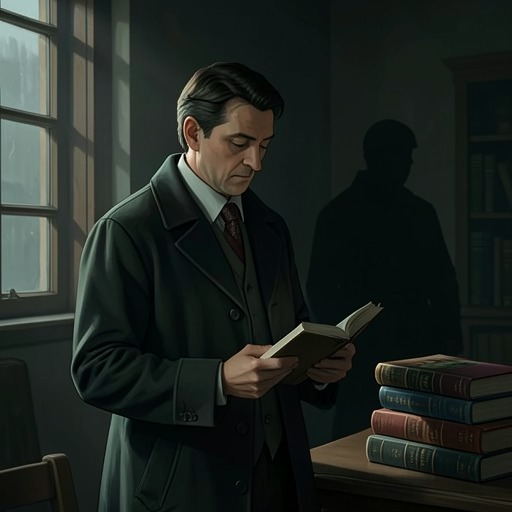
Roquefort read the novel on a crowded second-class train to Lyons. Sharing the compartment with two disapproving nuns, he initially used the book to withdraw from their scrutiny. The reading then absorbed him through the night: he lost awareness of the sisters, the passing stations, and the landscape outside. When he finished at daybreak, he was moved and astonished, but also envious of Carax’s achievement.
That response led him to seek the author’s other books during his regular visits to Paris. For ten years he searched secondhand shops without finding another novel. Reports that Carax had published further books remained uncertain, and even the title The Cathedral Thief came to him only as a bookseller’s doubtful recollection. When Roquefort heard at the end of 1935 that Carax’s The Shadow of the Wind had appeared from a small Paris firm, he wrote to ask for copies but received no answer.
In the spring of 1936, the bookseller told him that Carax’s circumstances might have improved: the author was reportedly about to marry a socially prominent woman, and his latest novel had earned a favorable review in Le Monde. Yet the news was followed by stories of a duel at Père Lachaise cemetery, at dawn on the day of the wedding, after which Carax did not appear at the church. Accounts disagreed about his fate. Some said he had died in the duel; others believed he had fled Paris and returned to Barcelona. A later rumor placed his death in poverty there, with the money collected for his burial arriving too late to prevent his interment in a common grave. These conflicting reports remained rumors in Roquefort’s account, but they reinforced the sense that Carax’s life and books were being lost together.
The Book’s Afterlife
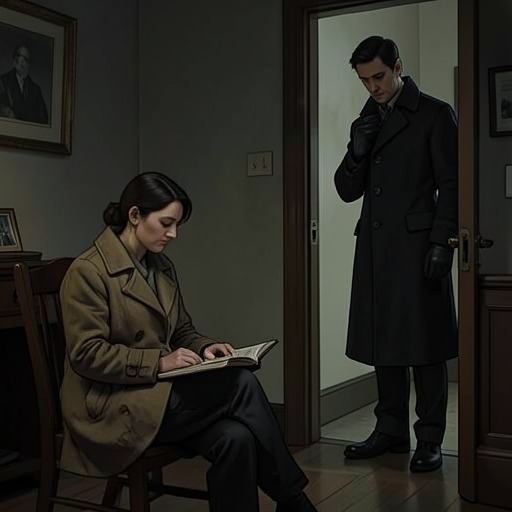
Eleven years after finding The Red House, Roquefort lent it to his pupils, Clara and Claudette, who were teenagers and had shown little interest in the classics, fables, or poetry he had tried to teach them. Hoping to awaken their interest in reading, he presented Carax’s novel as a love story. That description was only partly accurate, but it offered the girls an entry into a book whose darker plot might otherwise have put them off.
Clara later recalled that the novel was the first story to make her feel caught up in reading. Until then, reading had seemed like a duty imposed by teachers and tutors. The book opened for her the pleasure of imagination, beauty, language, and the exploration of inner life. She compared the excitement of discovering it to a first, unforgettable spark, and explained that reading allowed her to live more intensely and, in a figurative sense, restored sight she had lost. A book that mattered to almost no one else thus became decisive in her life.
The novel’s significance lies in this reversal between public failure and private effect. Its tiny sales, scant reviews, and near-disappearance from circulation do not determine what it can mean to a reader. Roquefort’s persistence carries the book beyond its neglected publication, and Clara’s experience shows how a work dismissed by the literary world can become an intimate discovery. The story about concealed identities and family secrets is itself passed from one reader to another, acquiring a new consequence each time it is read.